
Hawaiʻi County Arrest Report Archive
The county's multi-day source is the official HPD booking-log archive. There is no separately named weekly or monthly HTML blotter. Instead, the landing page lines up a run of daily PDFs. Each report spans a rolling 48-hour period, so one file overlaps the next. Read together, they offer recent historical context. They are not a true long-range arrest database. Nor are they a live jail count.
The public page typically carries roughly nine or ten dated files. That depth is a habit, not a promise. HPD posts no fixed day count. There is no formal retention period and no stated home for older links. When an older file drops off, the landing page has simply rolled forward. A vanished link says nothing about the underlying record. It says nothing about a sealing order either.
The captured official archive shows the dated-report format used to assemble this broader view.
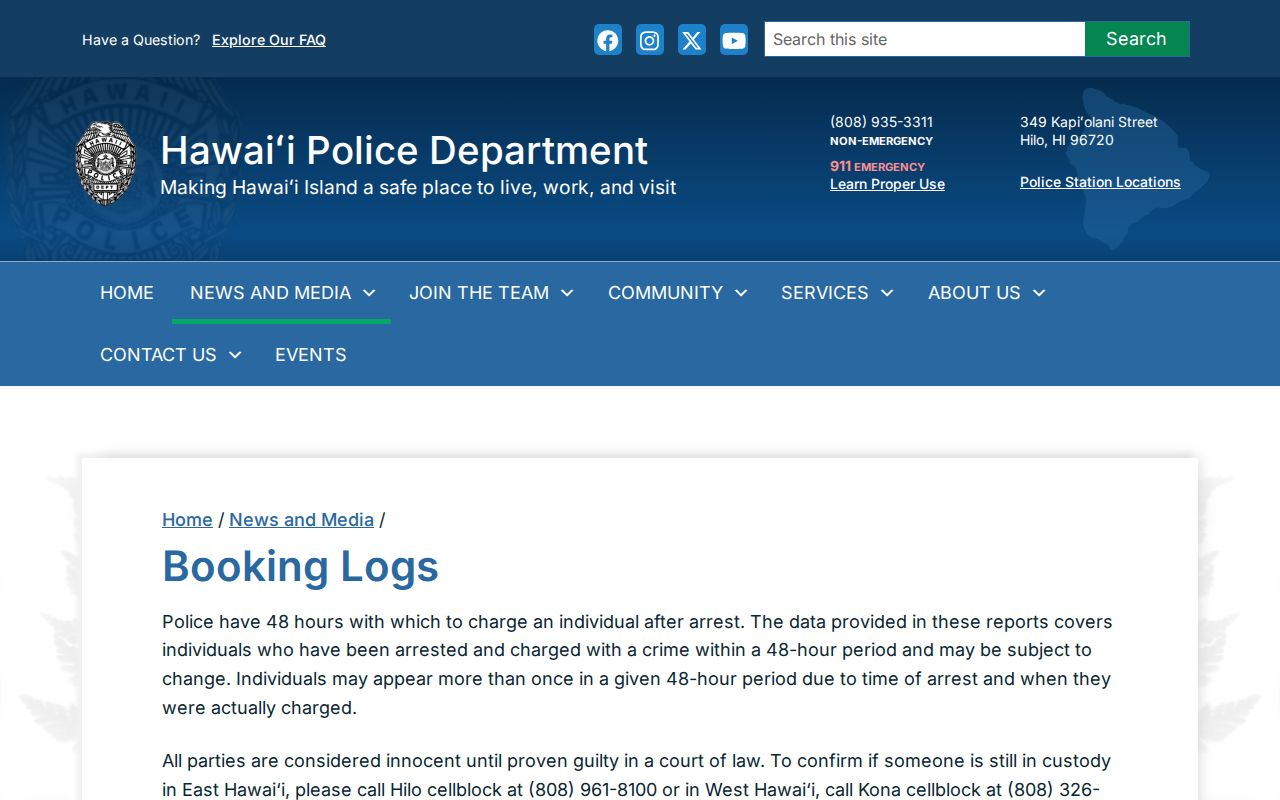
Open each file and read the printed period instead of trusting the date in its filename.
Read Hawaiʻi Arrest Reports
A sound blotter search walks backward through the official dates. It also tracks repeated details. Rows that look like twins may not be. Compare report numbers, OTN labels, arrest times, and charges before merging anything. One entry can reflect a different charge or a different point in processing. Release fields can shift too. The PDFs never promise a full custody history.
- Open the newest report whose printed coverage period includes the date of interest.
- Search the person's exact name, then record every matching report number and OTN heading.
- Open the prior and next dated PDFs because their 48-hour periods overlap.
- Compare arrest, charge, bail, release, and court-code fields without treating a blank as a final status.
- Save the dated URL and coverage line before a link rolls off the landing page.
- Use HPD Records and Identification when the needed report is no longer displayed.
Only care about right now? Start on Arrested Today. The multi-file method earns its keep when an arrest landed near a cutoff, happened over a weekend, or surfaced after charging caught up. Neither view shows current cell occupancy.
Hawaiʻi Arrest Entry Details
These reports carry more than names and charges. Identity, officer, timing, bail, release, and court-reference fields all appear. No booking photograph is included. The same goes for a live housing location or medical and classification data. So is a guaranteed "in custody" flag missing. Keep the OTN wording intact. The reports carry no separate "Booking Number" label.
| Report element | How to read it across dates |
|---|---|
| Arrestee Name and identity fields | Match carefully; age, gender, race, and address are printed as HPD data |
| Arrested On / Released On | Compare event times across overlapping files |
| Arresting Officer / Report # | Preserve these references for an agency request |
| Charges for OTN / Arrest Charge | Read each row as an charge, not a judgment |
| Bail Set / Bail Posted | Snapshot information that can change later |
| Release Description / Released By | Useful reported detail, but not a live roster |
| Court Code - Date | Starting clue for the court record, not a disposition |
| Photo | No booking photo appears in the HPD PDFs |
A booking charge is a preliminary figure. A later prosecutor filing can differ from it. The Judiciary record supplies the case proceedings and final disposition, not a blotter row or a news story.
Weekend Arrest Report Overlap
Weekend and holiday searches deserve extra care, though not because HPD announces any surge schedule. The archive has shown consecutive weekend dates. Report times clustered near 6:03 a.m. That points to a regular early-morning publication rhythm. The landing page gives no assurance about holidays or service interruptions. It does not promise the same cadence every time.
Overlap cuts both ways. A weekend arrest can show up in two PDFs at once. Or one file may hold the arrest, and a neighbor may hold the later charge or release. Read every printed time range. A Monday filename may cover part of Saturday or Sunday. A name missing from Monday's report calls for a check of neighboring files. It also calls for the right custody contact, not a conclusion that no arrest occurred.
For cellblock questions, HPD gives East Hawaiʻi adult-arrest information at (808) 961-2213. West Hawaiʻi information is available at (808) 326-4646 extension 293. Once someone transfers into state custody, other systems may apply. Hawaiʻi SAVIN/VINELink or Hawaiʻi Community Correctional Center can help there. Those systems answer custody questions. They are not archive substitutes.
Older Hawaiʻi Arrest Records
HPD's public page says nothing about where a PDF goes once its link disappears. For an older arrest report, contact HPD Records and Identification. The address is 349 Kapiʻolani Street, Hilo, HI 96720, and the phone is (808) 961-2233. Ask for three separate items. Request the underlying booking report, the date-specific media PDF if it is still maintained, and any releasable booking photograph. Supply the full name, approximate date, district, report number, OTN label, and any former URL you have.
The HPD reports and records page lays out in-person, telephone, and written request routes, along with fee and redaction rules. Personal identifiers, medical or financial material, juvenile information, and other protected content can be withheld. Some of it can be blacked out entirely. A public-record request never guarantees that every field or image will come out. The Office of Information Practices Records Report System helps identify a record title, responsible office, storage method, retention description, legal authority, and public or confidential status. It describes government record series, not individual booking files. State schedules do not apply automatically to HPD's county records. A link's disappearance is not an archival finding.
Note: Save the exact PDF and coverage text while available; the visible archive depth can change without defining official retention.
Local Arrest News Is Selective
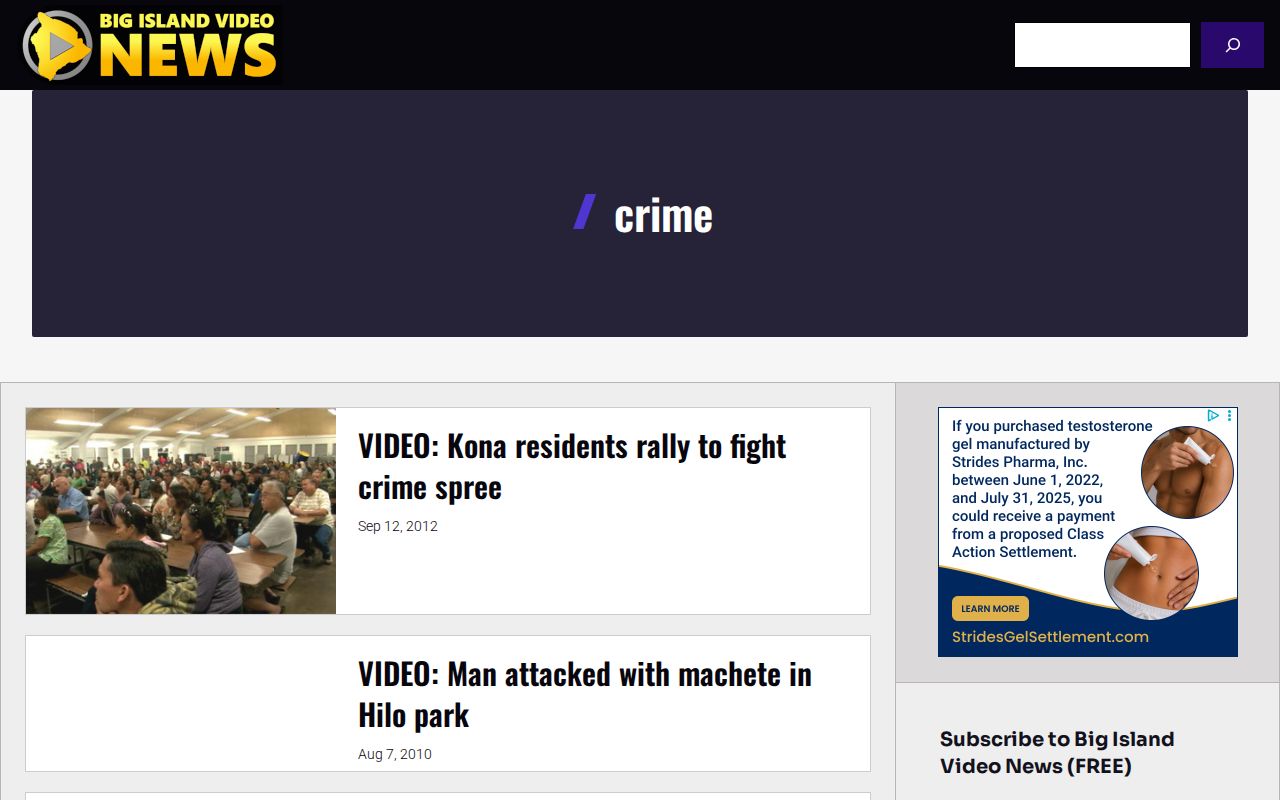
Start with the HPD records themselves. A newsroom covers what an editor picks, so a missing name tells you nothing about who was actually booked in Hawaiʻi County. Big Island Now and Big Island Video News keep crime archives spanning Hilo, Kona, Puna, and other districts. The Hawaiʻi Tribune-Herald news section runs selected arrest and court stories too, timed to events rather than to the daily HPD files. Treat it as local-news discovery. It is not an arrest roster.

Coverage gaps are not custody gaps. The Big Island Video News crime archive offers event-based island reporting, nothing more.
One caution about images. A scene photo or a picture supplied by the agency is not automatically a booking photo. So label nothing a mugshot without confirmation. West Hawaiʻi Today has a historical arrest log covering North and South Kohala, Kona, and Hāmākua. That item is an archive piece, not a current county feed. News can run stale or get details wrong. Check claims against the dated HPD report and the later court record.
Hawaiʻi Arrest Trends Need Context
Names alone make a weak trend line. Overlapping HPD PDFs can double-count the same arrest, and the public archive only spans a short window. HPD's annual DUI statistics work better as an enforcement log, giving islandwide and district totals, collision-linked arrests, and under-21 breakdowns without turning into a photo gallery. The figures track police activity, that is all.
For wider official context, the Hawaiʻi Crime Dashboard publishes annual NIBRS data on arrests, offenses, clearances, locations, times, and demographics by agency and year. NIBRS stands for the National Incident-Based Reporting System. The dashboard counts statistics only. It cannot show who entered HPD custody or how a case ended.
Keep each source in its lane. HPD PDFs log recent arrest and charge events. Annual stats support trend analysis. News explains selected incidents. Phone lines and VINE track custody at different stages. The courts finish the story.