
Hawaiʻi County Recent Arrest Feed
The Hawaiʻi Police Department is known locally as HPD. It publishes the county's official recent-booking source as dated PDF files. Think of it as one countywide police report. Hilo, Kona, Puna, and the other districts run no separate municipal arrest feeds of their own. Each report covers a rolling 48-hour window. Police have up to 48 hours after an arrest to file charges. That timing makes the file broader than a strict midnight-to-midnight arrest list. One more quirk: a name can show up twice. The arrest and charge times can land in different parts of the report.
| Official view | Best use | Key limit |
|---|---|---|
| Newest HPD PDF | Recent arrests and charges | Rolling 48 hours, not a live headcount |
| Several dated PDFs | Multi-day event review | Shallow web archive |
| Cellblock phone | Fresh pre-court custody | No online roster |
| SAVIN/VINELink | DCR custody and alerts | Excludes police cellblocks |
For the newest file, use Arrested Today; to work backward across several PDFs, use Arrest Reports. The official HPD booking-log archive displays the dated files readers must open.
This official page is the starting point for countywide recent booking entries.
Hawaiʻi County Arrest Custody Map
No public roster of current Hawaiʻi County custody exists with booking photos. So the accurate path is a chain, not one search box. A person may first be held in an HPD cellblock. After court, someone who stays detained may enter Hawaiʻi Department of Corrections and Rehabilitation custody. That often means Hawaiʻi Community Correctional Center. HCCC is a state jail, not a county sheriff jail. State jails serve pretrial and short-term populations. They also hold some transitional sentenced populations.
- Open the newest HPD booking PDF and search the exact last name.
- Read Arrested On and Released On, but do not treat a blank as proof of custody.
- For pre-court custody, call Hilo at (808) 961-8100 or West Kona at (808) 326-4646 extension 293.
- After state transfer, check SAVIN/VINELink or call HCCC at (808) 933-0431.
- Use the court record for later charges and disposition.
HCCC runs two sites. The downtown Hilo jail sits at 60 Punahele Street, and Hale Nani sits in Panaʻewa. DCR lists a combined design capacity of 226 beds. That structure is one more reason not to guess. An exact location rarely follows from an HPD row. The HPD inmate-information page explains the cellblock and VINE boundary.
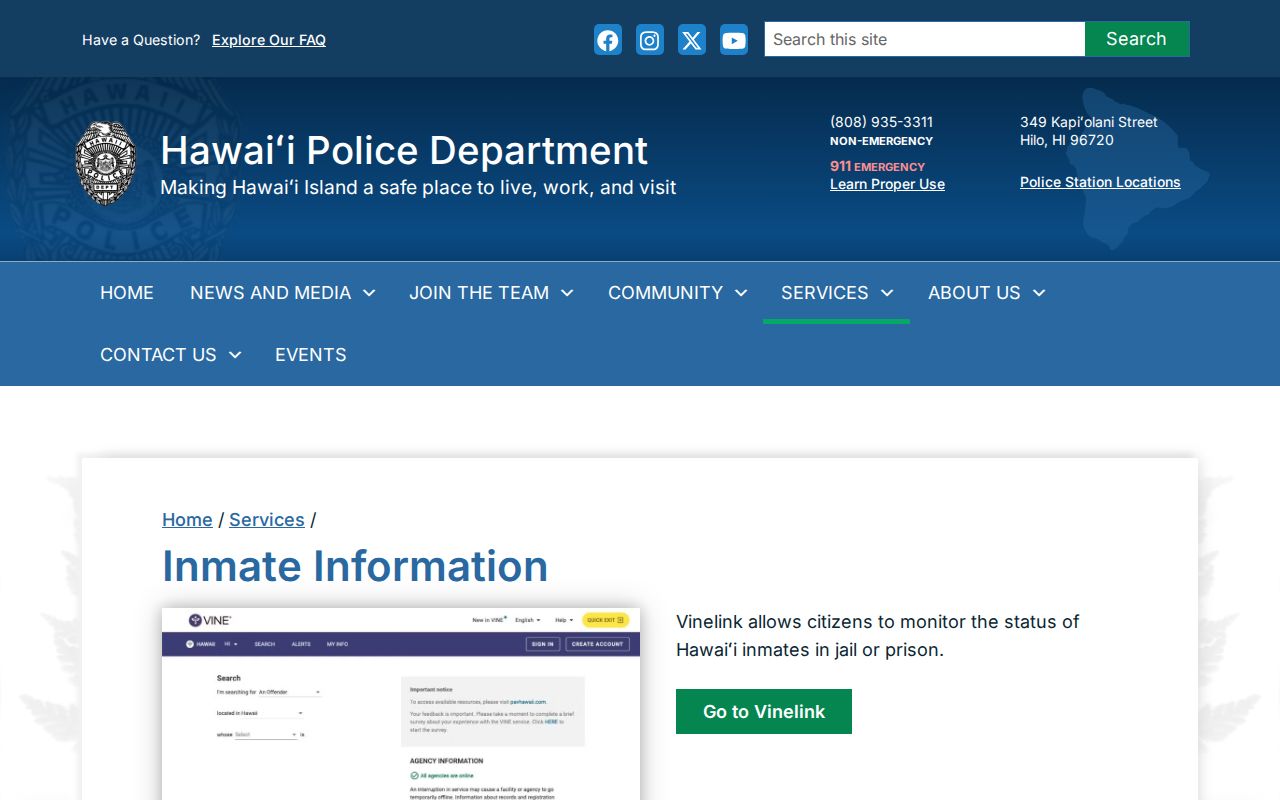
The official guidance routes fresh police custody differently from state custody.
Where Hawaiʻi Arrests Are Published
Each channel answers a narrower question than the last. Official sources must come first. News picks which stories to tell, and commercial directories can sit stale for months. Hawaiʻi County has no verified section at Busted Newspaper, RecentlyBooked, Mugshots.com, Arrests.org, or Mugshots.zone. A page built for another county cannot stand in as a Big Island source.
| Channel | Coverage | Photo | Status |
|---|---|---|---|
| HPD PDFs | Rolling arrest and charge reports | No | Official |
| HPD request | Releasable records and requested photo | By review | Official |
| VINELink | State custody and alerts | No gallery | Official |
| eCourt Kōkua | Cases and available documents | No gallery | Official |
| Local news | Selected events | Sometimes | Unofficial |
For added context, turn to Big Island Now, Big Island Video News, the Hawaiʻi Tribune-Herald, West Hawaiʻi Today, Hawaiʻi News Now, and Hawaiʻi Public Radio. These story-driven outlets can be incomplete, stale, or mistaken. They are not custody rosters. A missing story tells you nothing about whether a person was booked.
Recent Arrests by Hawaiʻi Place
The county has no incorporated Census places. It has no city police departments either. So these pages lean on the three largest census-designated places while keeping HPD's role front and center. Hilo Recent Arrests focuses on South Hilo and HCCC. Kailua Recent Arrests covers Kona Station and West Hawaiʻi intake. Hawaiian Paradise Park Recent Arrests explains Puna and Pāhoa coverage. Every record still flows through HPD. Nothing comes from a municipal roster.
Hawaiʻi County Arrest Record Fields
The PDF works on two linked layers. Identity and event fields name who HPD says was arrested and when. Charge and case fields then add early agency labels. There is no field literally called Booking Number. The report uses OTN in a charge heading, so copy that label exactly in any request.
| Field | Meaning |
|---|---|
| Arrested On / Released On | Event times, not guaranteed live status |
| Name, gender, age, race, address | Displayed identity details |
| Arresting Officer | Officer tied to the event |
| Report # / Charges for OTN | Request and charge references |
| Arrest Charge | Charge at booking |
| Bail Set / Bail Posted | Early bail information |
| Release Description / Released By | Release detail when populated |
| Court Code - Date | Court pointer, not the full docket |
Several charges can spread across several rows. Duplicate appearances can stem from the rolling arrest and charge timing. A blank release field proves nothing about detention. Confirm custody by phone or VINE, and use court records for the legal result.
Hawaiʻi Arrest Mugshots and Photos
The HPD PDFs are text only. They carry no photo column, and HPD posts no official online gallery. Any photograph HPD holds is a records-request question instead. Hawaiʻi Office of Information Practices Formal Opinion 94-12 dealt with mug shots kept by county police departments. It held that they are public government records under UIPA. Normal exceptions still apply. That ruling does not turn each image into an automatic online disclosure. Ask for any releasable photo tied to a named arrest. Include the full name, approximate date, district, and report number or OTN. Ask HPD to state whether it maintains the image. Also ask for the basis for withholding or redaction, the fee, and the response date. Juvenile details and personal, medical, or financial data may be withheld. The OIP booking-photo opinion provides the state analysis.
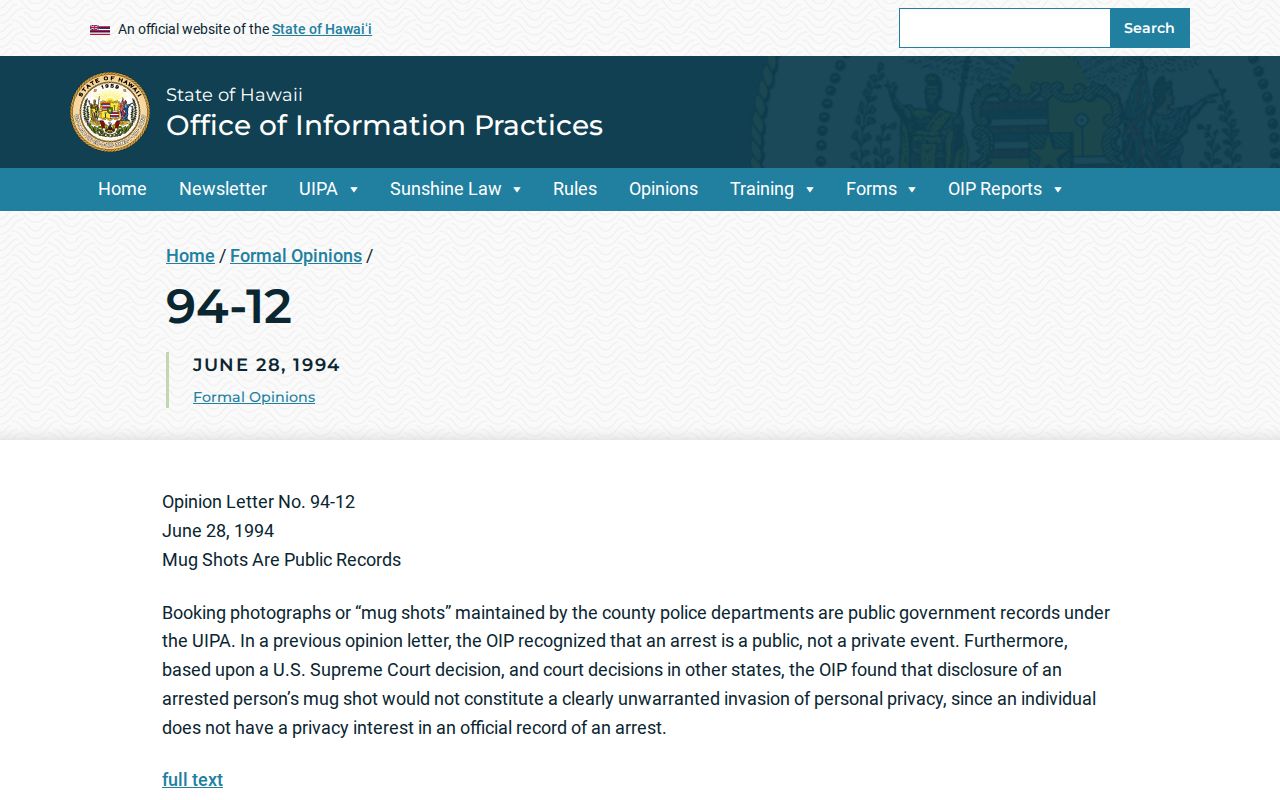
The opinion supports the request route. It preserves disclosure exceptions. No enacted Hawaiʻi law bans publication or sets up a broad pay-to-remove rule. Senate Bill 2631 proposed restrictions in 2024. It never became law. Fix the source record first. If an unofficial publisher later displays a photo, use only a verified free correction policy.
Request a Hawaiʻi Arrest Record
HPD Records and Identification takes requests in person, by phone, and in writing at 349 Kapiʻolani Street, Hilo, HI 96720, (808) 961-2233. The published police-report fee is $1 for the first page and ten cents per added page, cash only. HPD states a ten-business-day target. No photo-specific fee is listed, so ask first.
- Identify the person, date, and place.
- Copy the report number or OTN if shown.
- Describe the record and any releasable photograph.
- Ask for format, fee, response date, and the basis for redaction.
- Compare the response with the court case.
The HPD records page publishes the request methods.
This official source gives request routes, timing, fees, and redaction examples.
Hawaiʻi Arrest Law and Removal
Hawaiʻi splits its records rules across two laws. HRS Chapter 92F, the UIPA, governs access to government records, with privacy exceptions, personal-record access, and correction rights built in. Chapter 846 separates arrest information from formal charges, dispositions, and nonconviction data. That split matters. Deleting a web entry changes nothing in court.
Expungement runs through HCJDC. Its published route spells out eligibility limits, forms, fees, and a 120-day processing window. HRS §831-3.2 supplies the authority and the exclusions. Complete that official process, then present the order or agency confirmation through the publisher's free correction route; no outcome is promised, and this is not legal advice.
Juvenile details can be redacted by HPD. Courts keep sealed and confidential files offline. A name missing from view may reflect protection, age, or a short web archive, not the absence of an arrest.
Hawaiʻi Arrest Warrants and Wanted Notices
No complete public warrant list exists at the county level. The Judiciary's eBench system serves criminal-justice users only. For a real answer, contact the court, HPD, or a lawyer. The State DLE Sheriff Division serves state warrants and process. It never books county arrests. HPD posts wanted notices one at a time. Crime Stoppers backs some appeals, yet neither source amounts to a most-wanted roster. Never approach someone on the strength of a notice. Call 911 for immediate danger. You can also use the contact in the current release. The HPD media releases page is the official notice source.
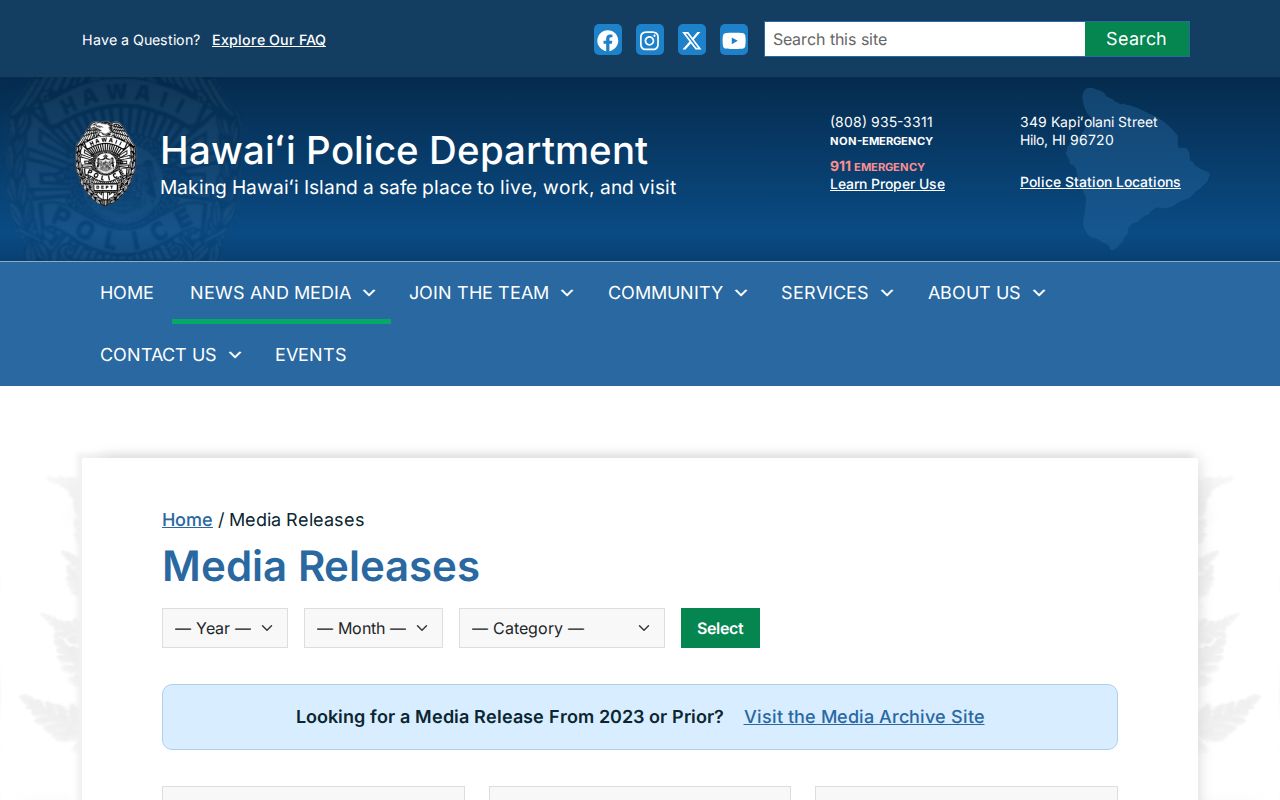
Wanted posts appear as individual releases, not a full warrant roster.
After a Hawaiʻi County Arrest
A booking row only starts the record. Prosecutors may file a different charge, judges may reset release terms, and the ending can be dismissal, acquittal, plea, conviction, or another disposition. eCourt Kōkua shows free basic case details. Available documents appear there too, though sealed, confidential, old, or undigitized items may not. The Judiciary access page explains the court route. Court records settle filed charges and final dispositions.
Hawaiʻi Arrest Timing and Trends
The archive often shows a shallow run of PDFs printed near 6:03 a.m. HPD guarantees no holiday schedule and no web-retention period. A late name may reflect the 48-hour charge window. HPD has also warned about false arrest images online. Check dates and agency domains before repeating anything. For numbers, the Hawaiʻi Crime Dashboard posts annual NIBRS data without names. HPD's 2024 DUI report counted 964 islandwide arrests, up from 955 in 2023. Kona logged 347, South Hilo 290, and Puna 196.
Hawaiʻi Arrest Records Beyond the Feed
The public PDF archive is a convenience, not Hawaiʻi County's full retention schedule. HPD publishes no firm web-retention period for booking files. When a date drops off the landing page, send a focused request to Records and Identification. Be specific. Give the date range, the person, the police district, and any report number. A narrow, identifiable request helps the office separate the booking entry from an incident report or a later court file.
State tools add context. The Office of Information Practices Records Report System identifies record series, responsible offices, storage and retrieval details, public status, authority, and stated retention. The Hawaiʻi State Archives publishes general and agency schedules. Neither sets an HPD booking-log schedule. Older court material goes through Judiciary records; ask the courthouse about papers predating online coverage. Corrections history belongs to DCR. A current VINE result is not an archive.
Hawaiʻi Arrest Alerts Serve Different Jobs
HPD lists no official booking-photo app. Its current alert page routes emergency and public-safety notices through the county's Everbridge system. Older material points to Nixle. Neither service subscribes you to every new booking. VINE's mobile access does a different job. It tracks a named person once that person enters participating state custody. An emergency alert, a booking PDF, and a VINE notice will not move in lockstep.
That division matters after a fresh arrest. Start with the dated HPD report for the recorded arrest and charge. Call the correct cellblock for pre-court detention questions. Move to SAVIN/VINELink only when state custody may apply. Hawaiʻi Island has used manual notification requests during outages, so confirm with the facility. Keep identifying details and contact information current. Never lean on one automated alert for a safety decision.
Verify Hawaiʻi County Arrest Claims
Hawaiʻi Island has seen false arrest claims circulate. HPD once warned the public about a fabricated report. It borrowed an image and claimed arrests that never happened. An inquiry by the department confirmed the photo and its details were false. So a screenshot stripped of its source URL, report date, and agency context can do real damage. Begin with the HPD booking archive instead. Keep the PDF date and report number, then compare the claim against the later court file. News photos deserve a closer look too. A caption may reveal that the image is agency-supplied, a scene shot, or an old file photo rather than a booking portrait. Identity checks matter just as much. Similar names and repeat rows trip people up. Hawaiʻi names and place names often carry the ʻokina or kahakō, yet many databases store a plain-text version. Try a careful variant of the spelling. Then weigh age, arrest time, district, officer, report number, and court code together before trusting a match on the name alone. When a source contradicts itself, ask the originating office to clarify the record rather than relying on it.
Hawaiʻi Custody After Arrest
Custody questions follow every Hawaiʻi County arrest. Once someone moves into participating DCR custody, VINE Arrest Check handles status alerts. It does not reach an HPD cellblock. Federal custody is outside its scope too. Island governance records note that manual notification requests can go to HCCC during outages, so direct confirmation still has value. The BOP Inmate Locator tracks federal inmates from 1982 onward. It plays no photo-gallery role. ICE's locator covers qualifying ICE or CBP custody. U.S. Marshals custody flows from a federal court order and stays separate from HPD booking; prisoner location and booking photographs are generally not released. Kulani Correctional Facility is a Big Island state prison. It is not the county jail. A sentenced person can slip past the short HPD booking window and surface later in a different state-custody setting. And someone named in an HPD report may be released without ever reaching HCCC or prison. Match each source to its own stage rather than assuming every arrest follows one custody path.